 I. The Seduction of the Monumental
What does a landscape ask of the eye when it refuses to whisper?
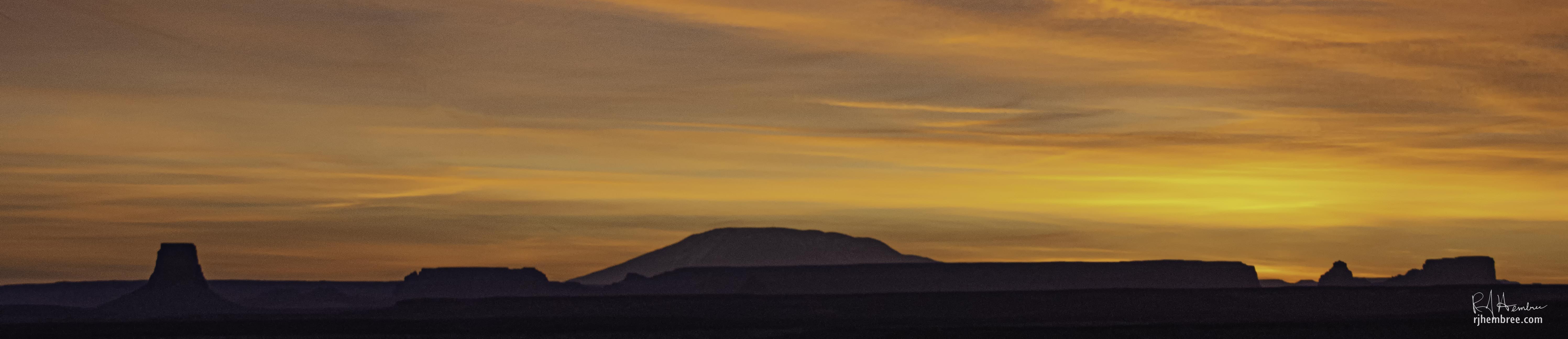
For seven years, the Colorado Plateau did not request attention; it commandeered it. In that high desert basin, the earth had long ago surrendered its flesh to reveal pure bone—vast amphitheaters of Jurassic Navajo sandstone, cross-bedded by ancient winds and baked under an unmediated sky. Living there, one did not so much compose an image as accept an offering. The drama was elemental, theatrical, and ceaseless. You had only to pedal an electric bicycle out past the mesa’s rim or walk a few hundred paces into the slickrock silence at dawn, and the light would stage its daily opera: shadows pooling like dark ink in three-hundred-foot slots, the cliffs catching fire with mineral iron and manganese, the turquoise expanse of drowned canyons mirroring a sky stripped of all humidity.
It was a geography that flattered the lens. But monumentality is a subtle seducer. When every horizon presents a ready-made cathedral, the photographer’s vision gradually succumbs to a luxurious lethargy. The frame fills itself; the scale performs the heavy lifting. In the presence of such colossal architecture, one forgets the discipline of searching, mistaking the sheer magnitude of the world for the sharpness of one’s own sight. We become mere stenographers of the sublime, seduced into believing that beauty is an event that occurs only on a continental scale, rather than an act of quiet, rigorous translation.
II. The Foothill Shift: An Overdose of Green
To migrate from the desert’s clean, mineral skeleton into the foothills of the Sierra Nevada is to pass from an architecture of stone to an entanglement of living tissue.
Here, the horizon is neither distant nor decisive. It dissolves into undulating slopes of chaparral, scrub oak, and the pale, shimmering shields of manzanita leaves. Where Canyon Country spoke in bold, tectonic declarations—straight lines cleaved by gravity, sweeping curves carved by ancient water—the foothills murmur in a thousand overlapping dialects of green and straw. In late summer, the hills turn the color of cured parchment, punctuated by thickets of buckeye and gray pine that crowd the frame with chaotic, unchoreographed detail.
At first encounter, the eye revolts against this visual density. Used to the effortless majesty of towering buttes and three-hundred-foot drops, the lens feels trapped in the brush. Yosemite and Sequoia loom further up the range, brooding in their glacial granite, but down here in the foothills, the grand drama has retired. There are no ready-made pedestals. The landscape does not compose itself; it simply exists, untamed, subtle, and stubbornly domestic.
The initial instinct is to call it mundane—a flat, verdant repetition that offers no easy purchase for the shutter. Yet the failure belongs entirely to the observer. The earth has not lost its eloquence; it has merely lowered its voice. In this quieter terrain, beauty is not delivered on a colossal scale; it hides in the curve of a mahogany-red bough, in the silver dust clinging to drought-hardened foliage, waiting for an eye patient enough to sift signal from noise.
III. The Art of the Intimate Landscape
How do we learn to see when the world ceases to shout?
In the middle of the twentieth century, while his contemporaries scrambled up crags to capture thunderheads breaking over the Rockies, Eliot Porter turned his back on the summit. He knelt instead before the forest floor, pointing his lens at a tangle of wet leaves, the lichen-crusted bark of an alder, or a dry creek bed where pebbles lay in quiet communion. Porter christened this realm the intimate landscape. It was not a retreat from nature, but an immersion in it—a recognition that infinity resides as surely in the cellular grain of wood as in the chasm of an abyss. Decades later, William Eggleston would point a camera at a rusted tricycle or the contents of an open freezer, declaring that no corner of reality holds a monopoly on grace. The "democratic camera" dissolved the hierarchy of subjects; the miracle was never the thing itself, but the relationship forged between light, geometry, and the noticing eye.
In these foothills, the lesson returns with quiet urgency. The chaparral invites us to discard the habit of hunting for monuments and begin the archaeology of the immediate.
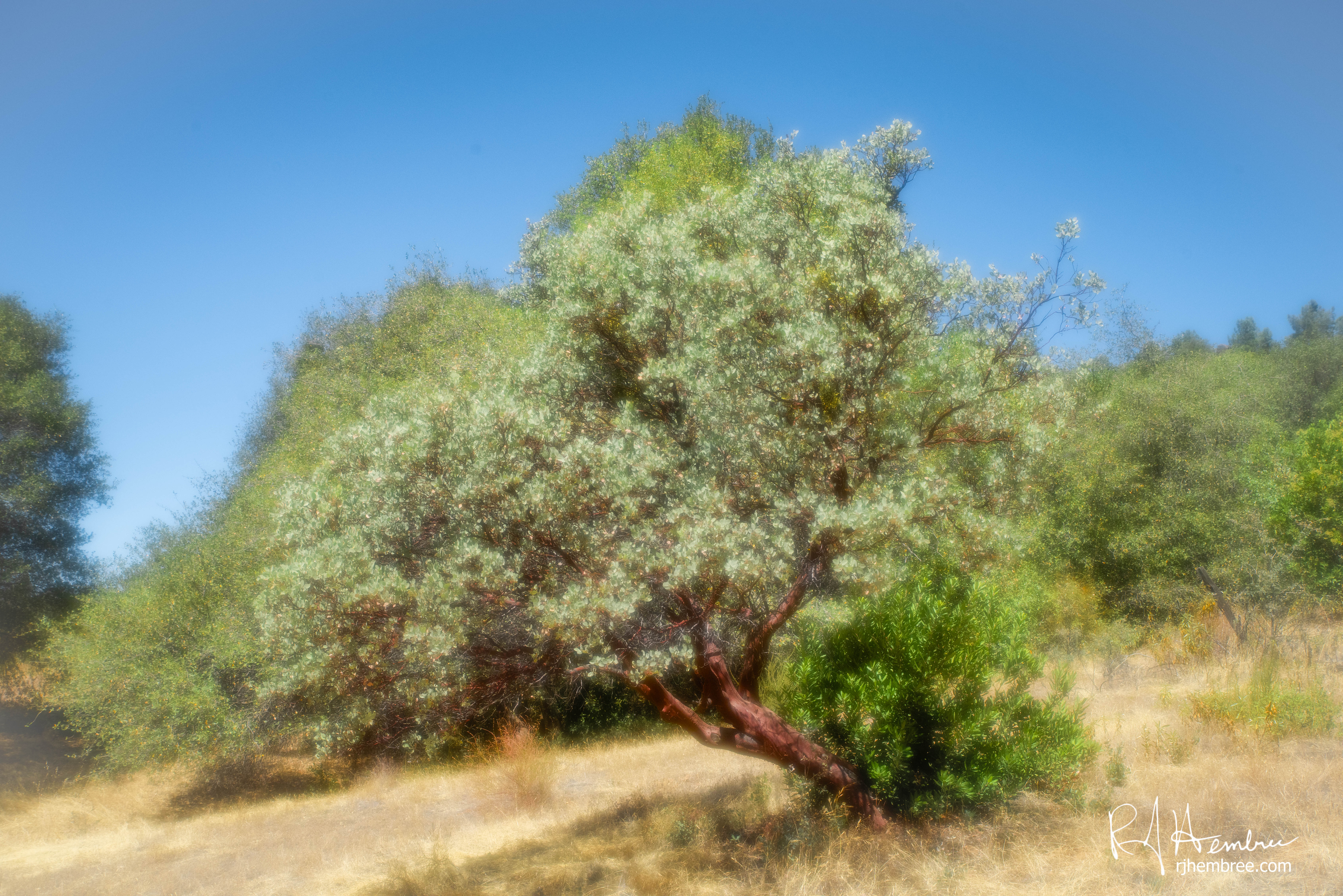
Look closely at the manzanita rooted in the scorched gold grass of an ordinary afternoon. It carries its own deep time, its muscular, blood-red wood twisting upward like petrified flame. The leaves do not simply reflect the sun; they catch it, holding a pale, glaucous dust that scatters the noon light into soft silver. To isolate this tree is not to settle for the mundane, but to excavate it. The frame becomes a vessel where the bleached hillside, the deep terracotta trunk, and the blue vault of the sky negotiate their boundaries. The eye stops demanding that nature perform, learning instead the subtle grammar of form, where a single sunlit limb holds enough mystery to anchor a world.
IV. Tactile Technique: Bringing Vision In-Camera
To alter how one sees often requires altering how one touches the world.
For years, the digital darkroom offered an intoxicating alchemy. In Photoshop, the Orton Effect—duplicating a layer, blurring its heart, and blending it back into sharpness—could conjure a luminous, painterly haze long after the field work was done. It was an afterthought of romance applied in cold pixels, an algorithmic daydream retrofitted over high-resolution capture. Yet something essential is surrendered when vision is deferred to a slider. To fix an image only in post-production is to remain a spectator at the moment of creation, postponing the act of witness until the light has already died.
Threading a physical disc of soft-diffusion glass onto the front of the Nikon D810 shifts the creative current entirely. It is a tactile intervention, like a musician plugging a vintage Stratocaster into a tube amplifier or finding an unfamiliar chord on a freshly tuned piano. The instrument itself begins to dictate the encounter.
Through the optical glass, the harsh midday California sun undergoes a sea change. The blinding glare bouncing off the manzanita’s silvery crown does not burn into clinical digital clipping; instead, it blooms, halating softly into the surrounding azure sky. The unforgiving micro-contrast of chaparral twigs melts into smooth, luminous planes, while the deep umber and mahogany of the trunk retain their solid, muscular core.
Working with physical glass demands immediate presence. You cannot simply point and resolve to rescue the emotion later; you must stand in the scorched grass, adjust your angle by inches, and watch through the viewfinder as the light physically bleeds across the frame. It slows the pulse. It restores the camera from a data-gathering machine to an expressive lens of intention, transforming an ordinary afternoon in the yard into an act of direct, unhurried seeing.
V. Cultivating the Active Eye
In the end, geography is only the canvas; the aperture is always the self.
To leave behind the monumental cliffs of Canyon Country is not an exile from wonder, but an invitation to wake up. When the drama is stripped away, the photographer is no longer a bystander collecting echoes of grand geologic spectacles. We are thrown back onto our own resources, challenged to find the holy in the unheralded, to look at a single foothill tree in the midday glare and see not an obstacle of brush, but an architecture of light.
The camera, weighted with glass and intention, becomes an instrument of attention. It reminds us that looking is a passive condition, but seeing is an active, generative art. The true craft does not demand that we constantly journey to the edges of the continent or stand before designated wonders to feel the pulse of the world. It asks only that we step into the dry grass of our own backyards, breathe in the scent of warm dust and pine resin, and wait for the sun to strike the leaves just so.
Creativity is kept fresh not by the novelty of the destination, but by the relentless discipline of our noticing. When we learn to frame the ordinary with reverence, the mundane ceases to exist—dissolving into an endless landscape of quiet miracles, waiting simply for someone patient enough to press the shutter.